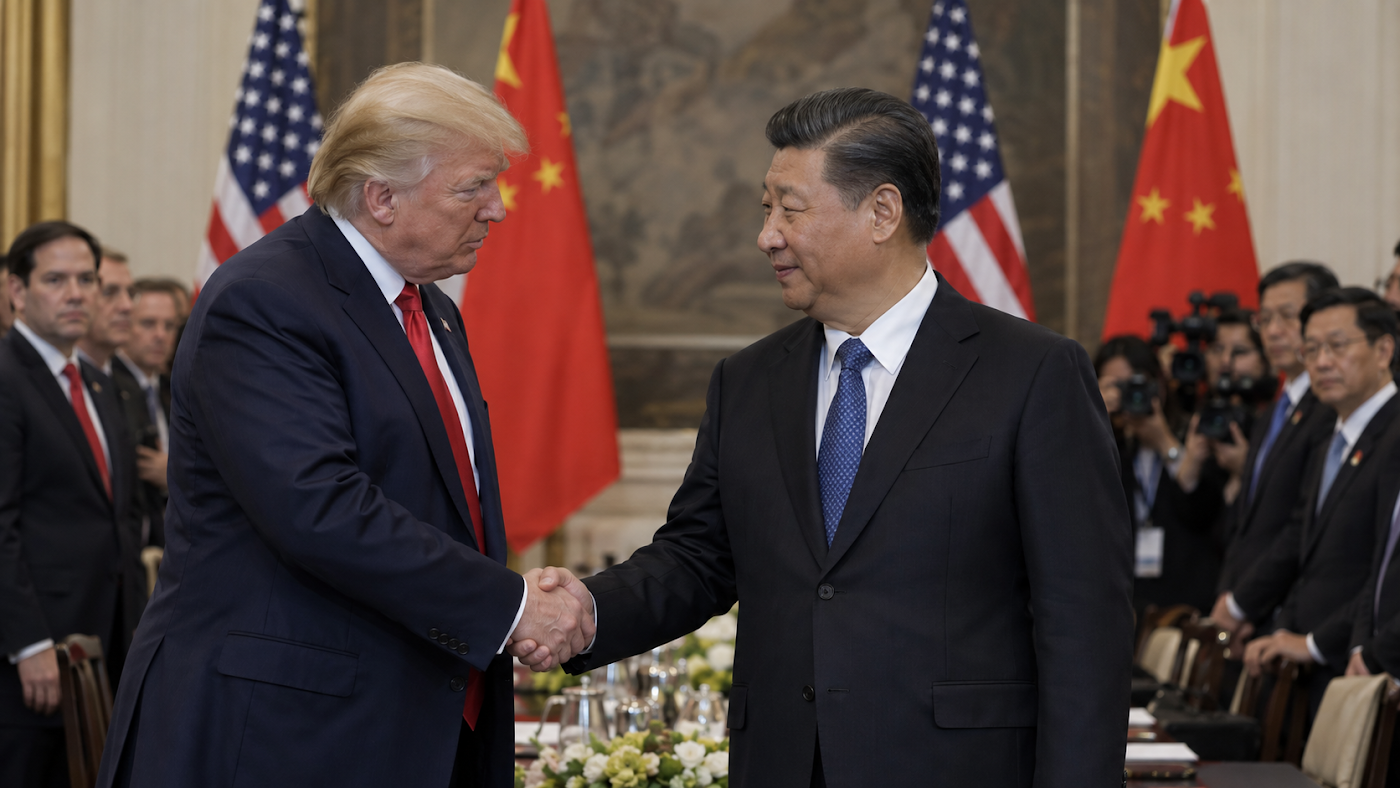
Monday opens with a cleaner screen and an unfinished oil map.Dow futures rose about 407 points. S&P 500 futures gained 0.7%. Nasdaq-100 futures climbed 1.1% as U.S. futures rallied after a mostly weak week. Oil did the work. WTI fell about 3% to $97.09. Brent dropped more than 3% to about $100.50. That is a clear break from Friday’s tension, when oil slipped under $100 but the 10-year still closed above five. The relief came from flow, not repair. JPMorgan said Middle East oil flows averaged 17.1 million barrels a day over the past 10 days, still below the 2025 average, but stronger than feared after the East-West pipeline disruption. The Dow enters the week down 1.7%. The S&P is near flat. The Nasdaq is still positive. Prediction markets are not pricing the route as fixed. Polymarket puts a Saudi East-West pipeline restart by September 22 at 3%. September 30 sits at 32%. October 31 sits at 77%. Traditional markets are buying the flow. Prediction markets are still watching the route. PREMIER FEATURE 7 AI Stocks to Lead the Next DecadeAI is fueling the Fourth Industrial Revolution – and these 7 stocks are front and center. One of them makes $40K accelerator chips with a full-stack platform that all but guarantees wide adoption. Another leads warehouse automation, with a $23B backlog – including all 47 distribution centers of a top U.S. retailer – plus a JV to lease robots to mid-market operators. From core infrastructure to automation leaders, these companies and other leaders are all in 7 AI Stocks to Invest in Today. Free today, grab it before the paywall locks. The lead signal is the gap between barrels moving and the route healing.The crude market says supply is finding a path. The pipeline market says the damaged path is still damaged. That difference matters. WTI below $98 lowers the inflation screen. It helps futures. It reduces some pressure on gasoline and freight. But it does not answer whether Saudi Arabia’s main east-west bypass is back, or whether the current workaround can survive another round of attacks. The pipeline book is the cleanest measure. A restart by September 22 sits at only 3%. September 30 sits at 32%. October 31 sits at 77%. That says the market sees a short-term workaround and a slower repair. The Bab el-Mandeb book is calmer. An effective closure by September 30 sits at 2%. October 31 is 12%. December 31 is 19%. So the market is not pricing a shipping shutdown today. It is pricing route risk that still has a clock. The Flow Without the Fix Barrels can move before routes heal. That keeps the relief conditional. The China story gave the rebound its second leg.Treasury Secretary Scott Bessent described talks with Chinese Vice Premier He Lifeng as very successful before the September 24 Trump-Xi summit. The U.S. proposed a formal AI dialogue and a notification system for major AI incidents with national-security risk. The two sides also discussed trade and critical minerals. The talks set up a summit focused on AI, trade and supply chains. Prediction markets are already leaning into that setup. Polymarket prices a U.S.-China tariff agreement by December 31 at 91%. Kalshi prices a Xi visit to the U.S. before November 1 at 99%, and before October 1 at 98%. That is not a full reset. It is a lower-friction path. The yuan touched its strongest level since January 2023 as markets positioned ahead of the summit. The move shows diplomacy is already entering prices, even before any final deal. The Summit Premium Markets are pricing lower trade friction. The actual terms still have to arrive. Rates still sit behind the rebound.Friday’s evening letter closed with the 10-year back above 5%. Monday opens with oil lower and futures higher, but the rate path has not vanished. That matters because the Fed just restarted hikes. Lower crude can cool one input. It cannot erase the language Warsh used last week, when the Fed framed the hike as removing a dose of accommodation. If policy is still viewed as support being removed, then the next meeting stays live. The global side adds pressure. The Bank of Japan just hiked to 1.25%, its highest rate since 1995. Higher U.S. rates and higher Japanese rates tighten two funding anchors at once. Gold fell about 0.5% to $4,356 as global yields stayed firm. That fits the same tape. The market is not trading a broad easing cycle. It is trading selective relief inside a higher-rate world. The Rate Floor Oil can ease. Funding costs still decide how much risk can rally. Prediction markets now have their own credibility test.Kalshi is facing questions over its new crypto perpetual futures after a critic flagged unusual ETH perpetual activity. The issue centered on about $539 million in 24-hour reported volume against about $3.1 million in open interest, plus repeated $5,500 trades that were said to make up a large share of volume on several days. Kalshi rejected the claim and argued the analysis mixed prediction-market volume rules with perpetual futures activity. Polymarket has a different problem. Fraudsters tried to steal at least $10 million from Polymarket’s U.S. platform by using stolen debit cards, and that one payment processor rejected more than 80% of deposits as fraudulent at one point, far above the roughly 1% industry norm. The report put fraud controls and growth incentives back in focus. That matters because prediction markets are moving deeper into finance. The same week brings oil-route contracts, China summit odds, AI dialogue pricing, and exchange-integrity questions. The market needs the signal. Regulators and users need to trust the pipe carrying it. The Signal Pipe Prediction markets price real events. Their own plumbing now matters too. PARTNER SPOTLIGHT Louis: The "Strawberry Problem" Is Stalling the AI Revolution
Billion-dollar tech investor Louis Navellier calls it "AI's darkest secret." Until AI models solve the "Strawberry Problem," they'll never create new breakthroughs in medicine, energy, or quantum computing. The good news? One company is about to solve the crisis… unleashing a new $100 trillion opportunity. Click here for details. This ad is sent on behalf of InvestorPlace Media at 1125 N. Charles Street, Baltimore, Maryland 21201. If you're not interested in this opportunity, please click here. Monday starts with relief, but not resolution.Oil is lower. Futures are higher. China talks improved the trade setup. The yuan strengthened. Prediction markets price a tariff agreement at 91% and a Xi visit before November at 99%. What is priced: Saudi pipeline restart by September 22 at 3%, September 30 at 32%, October 31 at 77%, Bab el-Mandeb closure by September 30 at 2%, and a U.S.-China tariff agreement by December 31 at 91%. What is not priced: another attack breaking the workaround, the East-West pipeline missing October, oil snapping back above $100, or prediction-market credibility becoming the next regulatory pressure point. The screen got lower oil. The route clock stayed open. Capital moves early. Coverage catches up. The gap between the two is worth watching. |
|