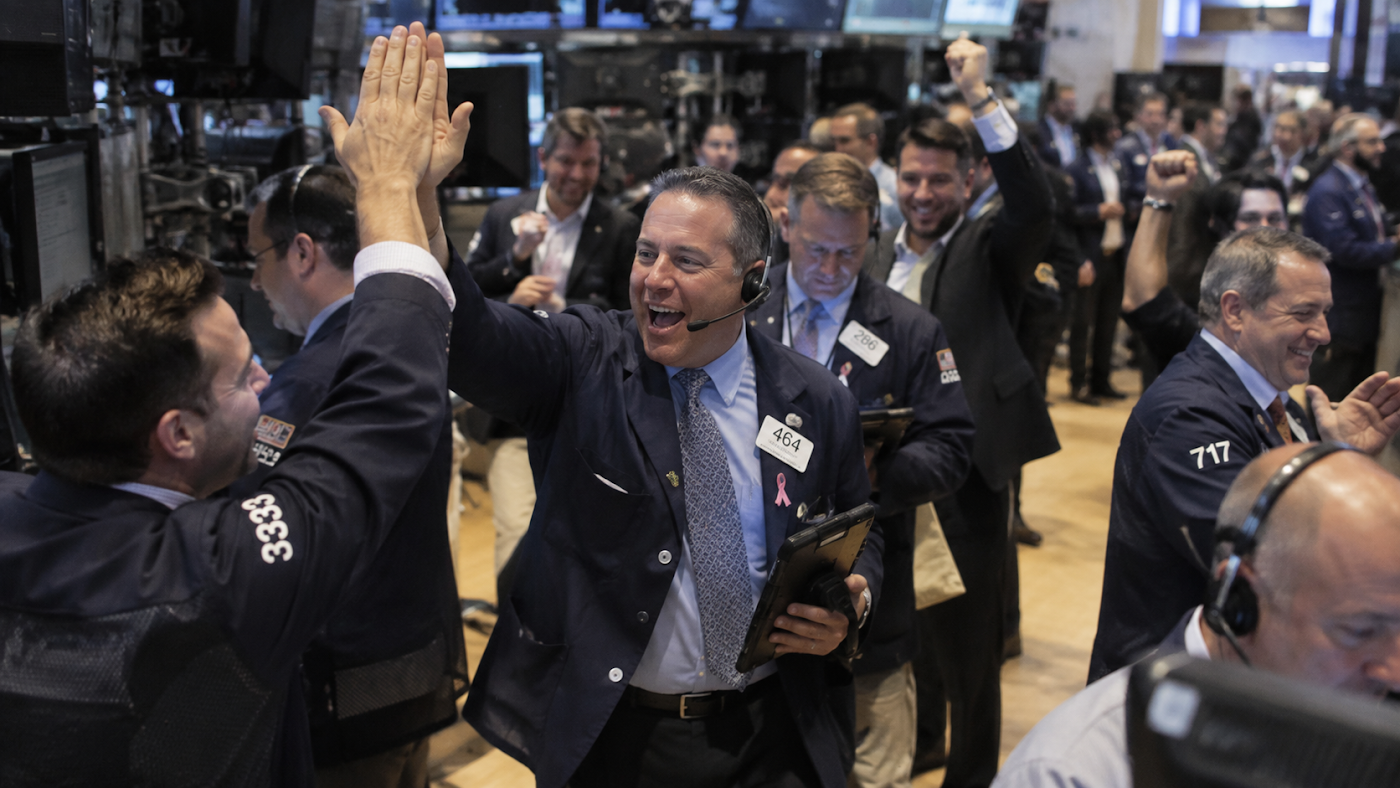
Monday gave the market the relief trade it wanted.The Nasdaq jumped 2.26%. The S&P gained 1.49%. The Dow rose 366 points. The VIX barely moved, off to 14.82. Oil did the work. WTI fell 4.68% to $95.61. The 10-year yield eased to 4.95%. Gold slipped almost 1% and the dollar was marginally stronger on the day. That is the clean part. The harder part: the route behind it still is not fixed. AI shares led on lower oil and yields. Intel (INTC) rose 11%. Advanced Micro Devices (AMD) gained roughly 8% to 10% and crossed a $1 trillion market cap. Qualcomm (QCOM) rose 8%. Meta Platforms (META) climbed nearly 12%. Prediction markets did not buy the repair. Polymarket prices the Saudi East-West pipeline restart at 2% by September 22. It prices the same restart at 31% by September 30, and 77% by October 31. The price broke lower Monday. The odds of a fast fix broke lower with it. PREMIER FEATURE Ex-CIA Analyst Warns: "Trump could create chaos with Russia and China.”Donald Trump is preparing a move that could reshape global power — and spark massive gains for early investors. Former CIA analyst Dr. Mark Skousen warns Trump’s hardline stance on China and Russia could ignite a global fight over critical minerals used in AI chips, EVs, and U.S. weapons systems. When the government quietly took stakes in similar companies, stocks surged 200%–300%+ in weeks. Now Skousen says the NEXT target is a tiny $5 American company — already backed by Tesla and $130M+ in U.S. grants. See his urgent briefing and the stock name here. Oil's relief came from flow, not repair.WTI closed near $95 and Brent near $100, which looks like a full break on the screen. The reason is narrower. Middle East exports held up better than feared, with Saudi shipments through Hormuz increasing. The market also priced a chance that U.S.-Iran diplomacy could cool the war premium. That followed a signal from President Trump. He said he was open to meeting Iranian President Masoud Pezeshkian at the UN General Assembly. Together, that gave crude room to fall. It did not restore the pipeline. Prediction markets said so more sharply than the price did. Polymarket priced the September 22 restart at 12% on Friday. Monday, that fell to 2%. The September 30 restart fell from 54% to 31%, and October 31 slipped from 84% to 77%. Every horizon moved the same direction over the weekend: lower. The Workaround Discount This is a market pricing a detour, not a repair, and the detour got more entrenched, not less. Exporters found room around the outage, and diplomacy lowered the risk premium, which is why crude could fall. But Polymarket's own confidence in a near-term fix fell over that same weekend, across every restart horizon. Today's lower price is borrowed against a repair the market now rates less likely than it did Friday. The rate market confirmed Monday's relief. It did not erase the Fed's own path.The 10-year fell 4.5 basis points to 4.95%. That helped equities, especially the long-duration AI trade. Friday's problem did not fully reverse, though. The Fed has restarted hikes, and Warsh's "dose of accommodation" line left the next move open. Lower crude helps the inflation math. One weaker oil close does not close out October or December. The oil route book agrees. Prediction markets price Bab el-Mandeb effectively closing by September 30 at just 1%. They price the same closure at 11% by October 31, and 19% by December 31. That is not panic. It is residual risk still on the books. The Rate Still Owed to Oil Losing the five handle reflects lower crude, not a settled Fed. The route book's low, rising curve says protection and repair must still happen to keep this relief alive. The next test for yields is not today's barrel, but whether it stays calm through October. China gave risk a second reason to rally, a channel separate from oil.Treasury Secretary Scott Bessent and Chinese Vice Premier He Lifeng met in New York. The talks laid groundwork for Thursday's summit between President Trump and Xi Jinping. Polymarket prices a U.S.-China tariff agreement by December 31 at 91%. Kalshi prices a Xi visit to the U.S. before November 1 at 99%, and before October 1 at 98%. Monday's rebound was never only about barrels. It also priced a cleaner trade path and lower supply-chain risk. A tariff deal would not solve the rate problem. It would only lower one source of pressure while the Fed stays tight. AI stocks liked that combination. Lower yields lifted growth, China talks lowered policy risk, and oil relief lowered inflation fear. That is why the Nasdaq, not the Dow, led Monday. The Stacked Relief Trade Three separate pressures eased on the same day: oil, yields, and trade policy. Stacked relief moves faster than single-source relief, and it unwinds the same way it built, one leg at a time. A setback in any one does not need the other two to follow. THE PREDICTION MARKET LAYER Crypto joined the relief trade, but its own infrastructure carried its own risk Monday.Bitcoin rose to $85,229, its highest since January. Coinbase (COIN), Circle (CRCL), and Strategy (MSTR) gained after recent SEC and CFTC moves eased regulatory uncertainty. Kalshi priced Bitcoin topping $90,000 in September at 37% and $100,000 before year-end at 38%. The exchange layer was less clean. A critic flagged roughly $539 million in 24-hour volume on Kalshi's Ethereum perpetual futures. Open interest was just $3.1 million, with repeated $5,500 trades. Kalshi called the analysis mixed-up. It said the analysis conflated products and misread volume reporting. Polymarket faced its own test. Fraudsters tried to steal at least $10 million from its U.S. platform with stolen debit cards. One processor reportedly rejected more than 80% of deposits as fraudulent at one point. The Credibility Tax Prediction markets are scaling faster than the controls meant to protect them. A venue's credibility is now part of what its prices carry, alongside the events themselves. PARTNER SPOTLIGHT Free Stock Pick: The Company First in Linefor America’s New Super Fuel The U.S. Army and Department of Energy are about to flip the switch on a revolutionary new fuel — and one obscure defense contractor has a five-year head start on every competitor. This joint, high-priority initiative — ordered by President Trump — is called Project Janus. And the first powerplant to run this new fuel is expected to go live before December 18, 2026… When it does, this company’s name will be everywhere. Full details — including the name and ticker symbol — are being revealed for free. 
Click HERE to get the stock name, ticker, and the full Project Janus story for free. Monday ran on three clocks, each moving at a different speed.The oil clock moved fastest, down almost 5% in a session. The repair clock moved slower, and it moved backward over the weekend, down to 31% by September 30 and 77% by October 31, both below Friday's levels. The shipping clock stayed calmest. Bab el-Mandeb's closure is priced at just 1% by September 30, 11% by October 31, and 19% by December 31. Hormuz runs on the longest clock of all. Kalshi prices traffic back to normal at 42% before July 2027. It prices the same traffic at 52% before January 2028, and 65% before July 2028. The Order the Clocks Run In A spot price answers what happened today. A repair contract answers how long the fix takes, and this weekend it answered with a worse number, not a better one. A traffic contract answers how long trust in it takes to rebuild. That order is the difference between a market that looks calm and a route that is getting harder to fix. Monday answered the morning with a stronger rally and a repair outlook that got worse, not better.Oil broke lower. The Nasdaq surged. The 10-year eased. China talks helped. Bitcoin reclaimed $85,000. What is priced: a Saudi pipeline restart at 31% by September 30 and 77% by October 31, both down from Friday's 54% and 84%. Bab el-Mandeb closing by September 30 sits at 1%. A U.S.-China tariff agreement by year-end sits at 91%. Hormuz traffic back to normal by January 2028 sits at 52%. What is not priced: the workaround failing, or the pipeline missing October. Also not priced is U.S.-Iran diplomacy breaking down. Nor is prediction-market credibility becoming the next drag on adoption. The screen got its relief. The route got harder to fix. Capital moves early. Coverage catches up. The gap between the two is worth watching. 3 Market Signals Most Investors Aren't Watching The headline is usually the last place the story shows up.
By the time everyone is talking about a stock… the signals underneath it may have been changing for weeks. • Institutional money moves. • Options activity changes. • Management confidence shifts. • Fundamentals improve, or quietly begin telling a different story. That’s exactly what our analysts found in three stocks where the evidence stopped agreeing with itself.
And in all three cases, the story is still developing. See the 3 Stocks, Get the Free Report → |
|