


Brent pulled back on Pakistan-led talks. Nasdaq still fell. Intel and Micron sold off. September hike odds moved above 50%.
The tape got relief. It did not believe it.
The Nasdaq fell 0.66%. The S&P slipped 0.03%. The Dow gained 168 points. The VIX barely moved, up 0.11% to 18.72.
Oil fell 3.17% to $89.27. The 10-year yield eased to 4.68%. Gold gained 0.16%. The euro softened to 1.137.
That is the surface.
Underneath, Friday was not a rally.
Oil gave back some of the week’s shock after reports that Pakistan, with support from China, is exploring a path to restart U.S.-Iran talks.
Stocks tried to use it. They could not hold it.
The S&P turned slightly negative late. The Nasdaq stayed red. Chips dragged again. Intel (INTC) fell 6% despite strong earnings. Micron (MU) dropped 8%. Broadcom (AVGO), AMD (AMD), and SMH also weakened.
The tariff wall arrived. The peace headline arrived.
The tape still closed defensive.
7 AI Stocks to Lead the Next Decade
AI is fueling the Fourth Industrial Revolution – and these 7 stocks are front and center.
One of them makes $40K accelerator chips with a full-stack platform that all but guarantees wide adoption.
Another leads warehouse automation, with a $23B backlog – including all 47 distribution centers of a top U.S. retailer – plus a JV to lease robots to mid-market operators.
From core infrastructure to automation leaders, these companies and other leaders are all in 7 AI Stocks to Invest in Today.
Free today, grab it before the paywall locks.
Diplomacy returned, but escalation stayed louder.
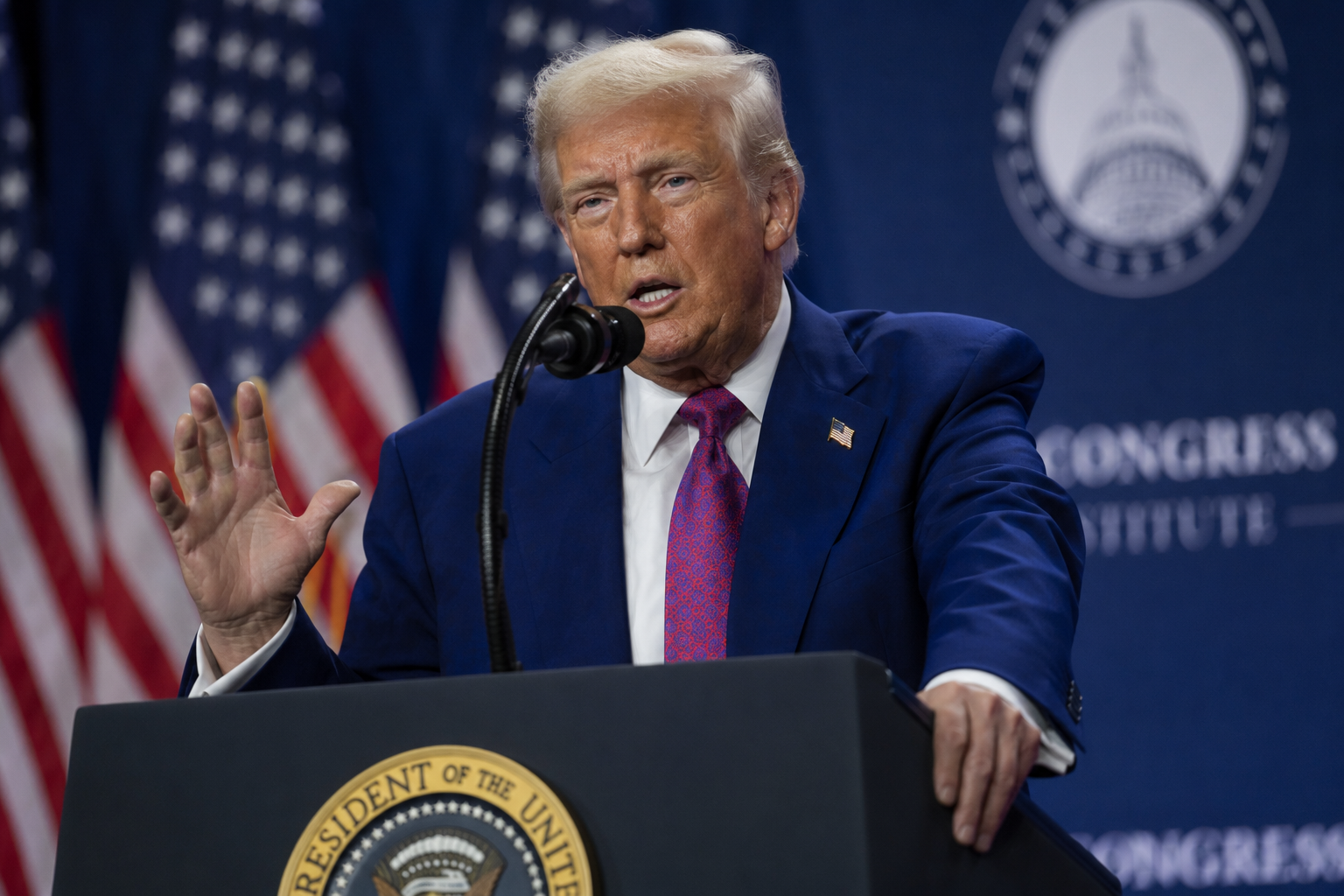
Trump said he is considering a massive attack on Iran. He told Axios the strikes would be bigger than anything seen in the war so far and said Iran has not received enough pain yet.
He gave no deadline. He said the U.S. is ready and Israel would join quickly if asked.
At the same time, Pakistan is trying to restart stalled U.S.-Iran peace talks with support from China. The effort followed another visit to Islamabad by Iran’s interior minister.
That split drove the day.
Oil fell because talks re-entered the tape. Risk stayed high because the White House kept escalation alive.
The U.S. also completed its 13th straight night of strikes on Iran.
The Diplomatic Fade
The market can fade oil on a talks headline. It cannot price peace while the next strike could be the largest one yet.
The chip trade could not use the oil break.
That was the clearest market signal.
Oil fell. Yields eased. The Dow rose. Apple (AAPL) gained 3%.
But the AI supply chain still sold off.
Intel’s strong earnings did not save the stock. Micron fell hard. SMH weakened again. The Nasdaq is set to lose more than 2% for the week.
That means the issue is no longer only macro.
The market has turned harder on AI capex, memory, and chip margins. Alphabet (GOOG) and Tesla (TSLA) already showed the cash-flow problem. Friday showed that even a better oil tape does not fix the semiconductor reset.
The Chip Tell
When oil falls and chips still sell, the problem is inside the trade.
Louis: The "Strawberry Problem" Is Stalling the AI Revolution

Billion-dollar tech investor Louis Navellier calls it "AI's darkest secret." Until AI models solve the "Strawberry Problem," they'll never create new breakthroughs in medicine, energy, or quantum computing. The good news? One company is about to solve the crisis… unleashing a new $100 trillion opportunity.
This ad is sent on behalf of InvestorPlace Media at 1125 N. Charles Street, Baltimore, Maryland 21201. If you're not interested in this opportunity, please click here.
The Fed path stayed tight.
Polymarket prices July no-change at 73.8%. A 25 basis point hike sits at 24.9%. A cut is below 1%.
September is now the main pressure point. A 25 basis point hike sits at 52%. No-change is 41%.
October also stays live. No-change is 54%. A 25 basis point hike is 32%. A cut is 10%.
That is not relief.
Oil fell on the day, but WTI still ended near $89 after crossing $90 this week. Brent is still high enough to feed freight, insurance, and inflation risk.
Hormuz traffic normal by August 31 sits at 11%. September 30 is 22%. December 31 is 52%.
A final U.S.-Iran nuclear deal by September 30 sits at 14%. December 31 is 30%.
The Fall Window
July may still hold. September now owns the oil risk, the tariff risk, and the earnings pass-through risk.
Prediction markets became investable, but not clean.
Split public exposure into four tiers because Kalshi and Polymarket remain private.
Tier one is infrastructure. CME Group (CME) and Interactive Brokers (IBKR) sit around exchange rails, clearing, futures access, and multi-asset trading.
Tier two is distribution. Robinhood (HOOD) is the cleanest large-cap read because event contracts are becoming part of its revenue model. Charles Schwab (SCHW) can also benefit from younger investor engagement and options-style demand.
Tier three is direct but volatile. DraftKings (DKNG) has launched DKeX, but the stock still carries spend-ahead-of-revenue risk.
Tier four is speculative exposure. ERShares XOVR ETF holds a $30 million direct Kalshi investment. Webull (BULL) is adding event contracts. Sports Entertainment Gaming Global (SEGG) is running its Sports.com Predict platform at micro-cap scale.
The theme is clear. The market wants prediction-market upside. The cleanest platforms are still private.
CLARITY Act odds fell to 37% for 2026.
The Exposure Gap
Prediction markets are now big enough to trade. Public investors still have to reach for second-order winners.
Buffett, Gates and Bezos Quietly Dumping Stocks—Here's Why
The world's wealthiest individuals are making huge moves with their money.
Warren Buffett just liquidated billions of shares. Bill Gates sold 500,000 shares of Microsoft. Jeff Bezos filed to sell Amazon shares worth $4.8 billion.
What is going on? One multi-millionaire believes they are preparing for a catastrophic event. But not a crash, bank run, or recession. It’s something we haven’t seen in America for more than a century.
Friday closed the week with a narrow message.
The cost stack eased, but did not clear.
Oil fell, but not because the war ended. It fell because a diplomatic path was floated.
The tariff regime arrived, but the market has not yet seen Q3 pass-through.
Chips fell, even with the macro tape less bad.
The Fed path held its hawkish shape.
And prediction markets kept turning from product into public-market theme, even as the rulebook stayed uncertain.
That is why the relief did not spread.
The market no longer rallies just because the worst price backs off for one day.
It needs proof that the cost stack is shrinking.
The Relief Test
A lower barrel helps. It does not undo a durable tariff wall, a weak chip tape, or a September hike now priced above 50%.
The close matched the morning’s warning.
The regime moved. The rout wanted relief. The tape got some, but not enough.
What is priced: a July Fed hold, a September hike as the live risk, a long Hormuz disruption, and public-market demand for prediction-market exposure.
What is not priced: Trump choosing the massive attack option, chip weakness spreading into the next AI earnings wave, Section 301 pass-through hitting guidance, or CLARITY odds falling further.
Oil eased.
The market did not relax.
Capital moves early. Coverage catches up. The gap between the two is worth watching.
