THE DAILY PULSE Oil fell, and stocks closed their first winning week in three.The Dow rose 478 points, or 0.9%. The S&P 500 gained 0.5%. The Nasdaq added 0.5%. The VIX slipped to about 15. WTI fell about $2 to under $93 after Iran laid out a path to reopen Hormuz. Treasuries split. The 2-year yield fell 6 basis points to 4.81%. The 10-year briefly pushed toward its highest level since 2007, then settled at 5.17%. The 30-year rose to 5.49%. The front end took the relief. The long end kept the pressure. PREMIER FEATURE I've Read a Lot of Mining Filings. They All Sound the Same.This one stopped me cold. Sitting in the filings of one small American gold company is a phrase I have never seen on a gold project: substantial support and partnership from the Department of War. The Department of War does not partner with gold miners. Except it's partnering with this one. Here's why. The deposit carries a second metal — one China formally banned from export to the United States. The only domestic reserve of it in the country. Gold for the dollar war. The banned metal for the shooting war. Both from the same pit. Washington didn't stop at words. On May 21, 2026, a federal bank voted unanimously to lend nearly $3 billion to build it. Congress got 25 days notice. Nobody objected. When final papers are signed, funding risk goes to zero — and Wall Street re-rates the stock from speculative developer to federally backed strategic asset. The company is about one fiftieth the size of Newmont. Read the filing for yourself THE LEAD SIGNAL Bond volatility rose on a day stock volatility fell.The MOVE index of Treasury volatility jumped almost 10% by Friday afternoon, to about 104.6. Long Treasury, high-yield and investment-grade bond funds all touched 52-week lows while the S&P 500 rose. The front end told a softer story. October hike odds slipped about 4 points on both Kalshi and Polymarket, to roughly 62% to 65%. Polymarket's 10-year ladder eased too. A 5.4% touch before 2027 sits at 50%, and 5.5% sits at 24%. The 5.4% and 5.5% rungs each lost six to eight points on the day. A 5.2% touch still trades at 91%. That contract settles on Treasury's daily par curve, which printed 5.17% on Friday, so it remains open. How Far Into the Fives The rate debate has moved past whether the 10-year can hold above 5%. It is now about how far into the fives it can climb. Friday trimmed the odds on 5.4% and 5.5%, yet bond volatility rose and the 30-year climbed. That split suggests less fear of a near-term hike, with no less risk in holding long bonds. Until long-end volatility cools, a rally built on cheaper oil rests on the short end of the curve. THE ARCHITECTURE Iran put a clock on Hormuz while Houthi missiles kept flying at Saudi Arabia.Foreign Minister Abbas Araghchi said Tehran would reopen the strait within seven days if its conditions are met. They include lifting the U.S. naval blockade, waiving oil sanctions and a ceasefire that covers Lebanon. A similar June understanding lapsed without being carried out. President Trump has said he is in no rush. Some barrels are already moving. Saudi Arabia is exporting about 6 million barrels a day in September, per Kpler, by routing crude through Hormuz. Total flows through the strait still run near 13.2 million barrels a day, against about 17 million before the war. The military map moved the other way. The Houthis fired dozens of missiles and drones at Saudi targets this week. Saudi, Turkish and Pakistani military chiefs are meeting on Saudi defense. The UAE, Oman and Iraq curbed Iranian flights. Polymarket prices a U.S. announcement ending the blockade by Dec. 31 at about 69%. Only an official U.S. statement settles that contract. Kalshi's contract on a signed nuclear deal sits near 10%. The Announcement Premium Traders are pricing a U.S. announcement far more readily than a signed deal. Both prices can hold if Washington lifts the blockade first and negotiates later. That order would ease crude well before it settles the conflict. If the seven-day offer draws no official answer, the discount oil gained Friday has little to rest on. FROM OUR PARTNERS Free Stock Pick: The Company First in Linefor America’s New Super Fuel The U.S. Army and Department of Energy are about to flip the switch on a revolutionary new fuel — and one obscure defense contractor has a five-year head start on every competitor. This joint, high-priority initiative — ordered by President Trump — is called Project Janus. And the first powerplant to run this new fuel is expected to go live before December 18, 2026… When it does, this company’s name will be everywhere. Full details — including the name and ticker symbol — are being revealed for free. 
Click HERE to get the stock name, ticker, and the full Project Janus story for free. THE CROSS-CURRENTS The pump rose on a day crude fell.AAA's national average climbed to $4.49 on Friday, up from $4.48 on Thursday and about 39 cents above a month ago. Kalshi puts a Monday reading above $4.50 at 2%, so traders there expect little further climb. Households are feeling it. Year-ahead inflation expectations rose to 4.6% in the final September Michigan survey, from 4.0% in August. Survey director Joanne Hsu pointed to worries about elevated fuel prices and trade disputes. AI spending pulled the other way. Anthropic committed $11.6 billion over seven years to Akamai's cloud. Akamai shares opened up about 14% and faded to about 6% by early afternoon as investors weighed the spending. The Pump Lag Crude relief has not reached the pump, and households have noticed. Year-ahead inflation expectations rose 0.6 points in a month while gas climbed 39 cents. That keeps an inflation channel open for the Fed even as oil falls. AI spending can keep lifting indexes, but it cannot close that channel. THE PREDICTION MARKET LAYER Prediction markets are pulling bettors from sportsbooks, and states are following the money.A Fullstory survey of more than 1,000 U.S. consumers found 35% of bettors use sportsbooks less because of prediction markets. Sixty percent said prediction markets changed how often they use sportsbooks. North Carolina will tax prediction markets at 6% of net trading-fee revenue from January. Its sportsbooks now pay 23%. The law adds no license or other regulatory duty for the venues. New York chose the courtroom. Polymarket sued New York in federal court hours after the state sued it. The complaint argues federal commodities law overrides state gambling law. The State Toolkit States now have more than one lever against a product that pulls bettors from sportsbooks. North Carolina picked a tax, and New York picked a lawsuit. Polymarket's countersuit turns the New York case into one more test of federal preemption. Until courts settle that question, each state lever adds to the cost of running the venues behind these prices. PARTNER SPOTLIGHT Satellite Confirms: Elon Musk Activating Strange 'Dark Energy' Across U.S. South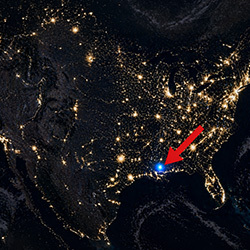
Confirmed by satellites 300 miles above the Earth's surface... Elon Musk is rolling out a breakthrough technology that could replace our need for foreign oil and ignite a $10 trillion boom a small group of stocks. Click here to learn how you can invest in this before it becomes mainstream. THE FORETELL LENS Friday's relief had a clear address. Lower oil eased the front of the curve, trimmed October hike odds and lifted stocks. The long end and the pump did not share it. Relief at the Front A rally built on the short end needs the long end to follow before it can last. Bond volatility rose instead, and gas kept climbing. If neither turns, Friday's bounce reads as a pause in the pressure rather than its end. FINAL FRAME Friday closed the week with relief at the front of the curve and pressure at the back.What is priced: a 5.4% 10-year at 50%, a U.S. blockade announcement by year-end at about 69%, and a signed nuclear deal near 10%. What is not priced: whether bond volatility spills into stocks, whether gas follows crude lower, or how New York's court fight ends. The bounce was real. It stopped at the front of the curve. Capital moves early. Coverage catches up. The gap between the two is worth watching. 3 Market Signals Most Investors Aren't WatchingThe headline is usually the last place the story shows up.
By the time everyone is talking about a stock… the signals underneath it may have been changing for weeks. • Institutional money moves. • Options activity changes. • Management confidence shifts. • Fundamentals improve, or quietly begin telling a different story. That’s exactly what our analysts found in three stocks where the evidence stopped agreeing with itself.
And in all three cases, the story is still developing. See the 3 Stocks, Get the Free Report → | 


